What a Wolt order really leaves you
A burger priced a euro higher on Wolt can still leave €2.25 less. How to work out contribution per delivery order, step by step.
Read the articleFoodNormIQ reads your supplier invoices, re-costs every recipe they touch and shows what each dish leaves you in the restaurant and on Wolt. You see the change the morning it happens, not when the month closes.
| Dish using beef | Plate cost | Wolt margin |
|---|---|---|
| Classic Smash | €2.51 | 39.4% |
| Double Smash | €3.96 | 36.2% |
| Bacon Smash | €3.16 | 37.4% |
| Chili cheese fries | €1.48 | 38.2% |
2 dishes are below your 38% Wolt target. To bring Double Smash back, its Wolt price needs to be €13.70 (now €12.90).
Case study: running todayon a two-location kitchen in Skopje, with its full 2026 purchase history.
Their setupSupplier invoices arrive by email and are saved to a shared folder automatically. The POS sends one sales file a day with Wolt orders included. Nobody types an invoice.
Where margin leaks
By the time the month closes, the money is gone. These four leaks sit underneath the percentage, and each one is visible earlier in the data you already have.
A 12% rise on one ingredient changes the cost of every recipe that uses it. Nobody re-costs the spreadsheet until it's too late.
Trim, cooking loss, sub-recipes and prep waste mean you buy more than you serve. Costing from the invoice alone flatters every dish.
Commission and packaging come off before anything reaches you. A higher Wolt price can still leave much less per order.
What the recipes say you used and what you actually bought drift apart quietly, one tray at a time.
Examples from the Bunbury & Co sample kitchen.
Classic Smash, one recipe, one plate cost of €2.51. On Wolt the menu price is a euro higher, and it still leaves €2.25 less per order once commission and packaging are paid.
How it worksone invoice, start to finish
Forward supplier invoices from your inbox, upload them, or photograph them on a phone. Each one is read, checked against its printed total and posted. You only review the lines it isn't sure about.
Every line, pack size and price is pulled from the invoice, including handwritten and Cyrillic ones.
BEEF CHUCK 80/20The supplier's wording is matched to your ingredient. Once you confirm a match, it's remembered.
Beef chuck, €9.64/kgEvery recipe that uses the ingredient is re-costed, sub-recipes and yields included.
4 dishes, +€0.06 to +€0.26Each dish is compared with your margin target on every sales channel.
2 Wolt margins below 38%It lands in This week with its monthly cost and what you could do about it.
−€317/moProduct toursample kitchen data
These screens show Bunbury & Co, a fictional three-store burger chain. On a demo we go through them live, with your questions and your own dishes.
Photos, PDFs, fiscal receipts and forwarded emails are read and checked against the printed total. Most post on their own. Only the ones that fail a check wait for you, with the reason shown.
See it on a demo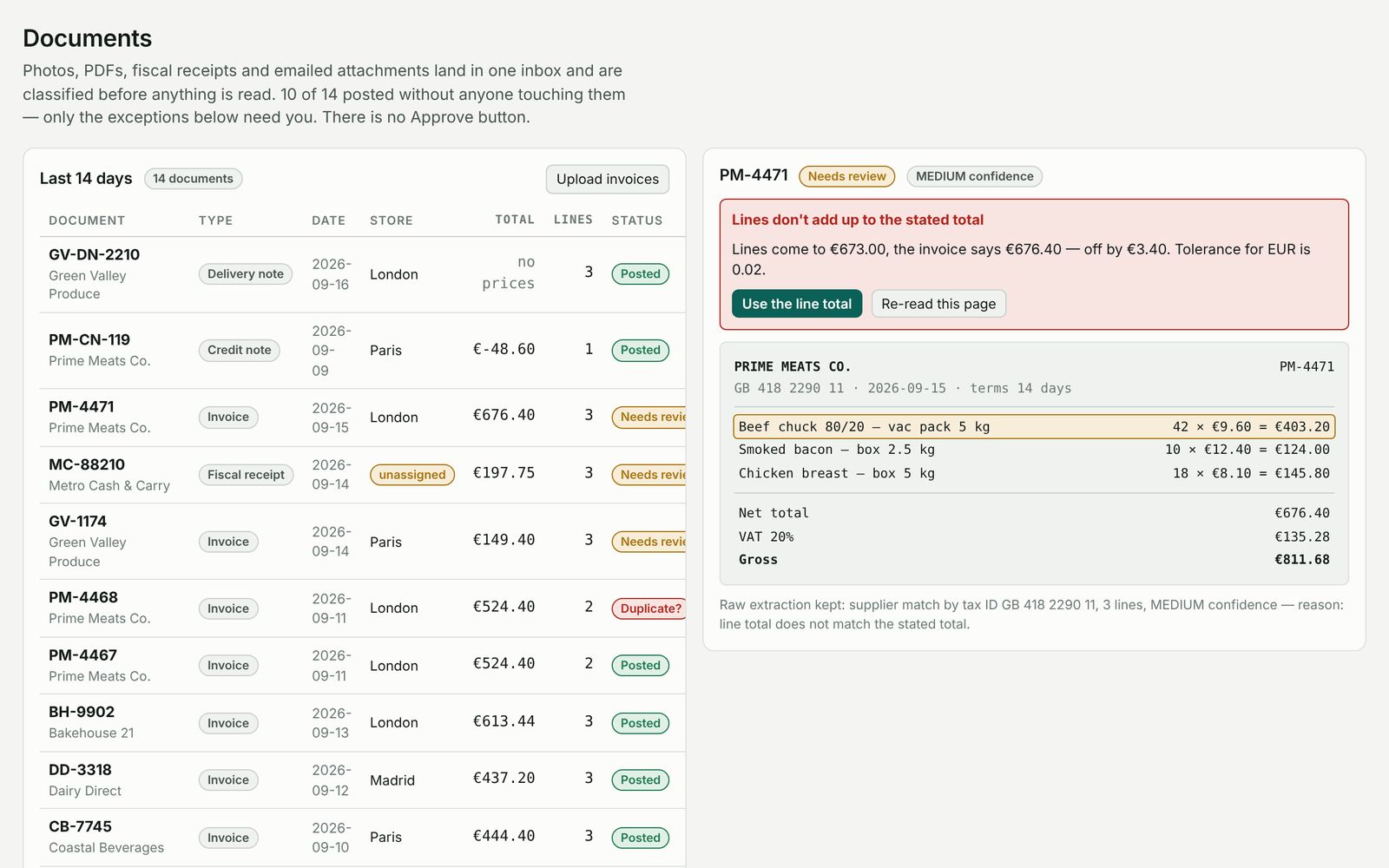
Every supplier item whose price changed in the last four weeks, sorted by what it costs you a month at your own volumes, with a 12-week trend.
See it on a demo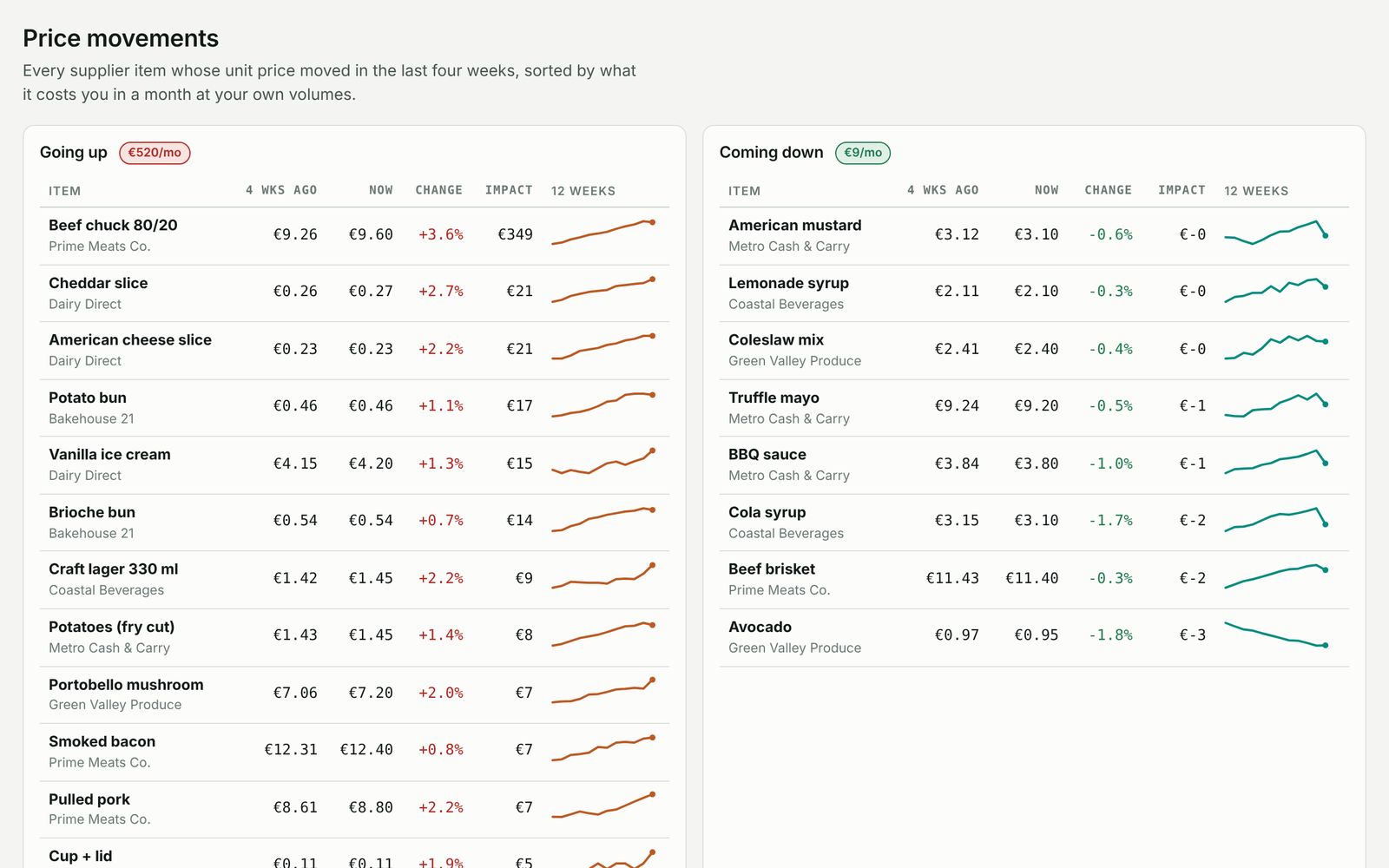
Units, plate cost, food cost and contribution for every dish, after packaging and delivery commission. Each number shows where it came from.
See it on a demo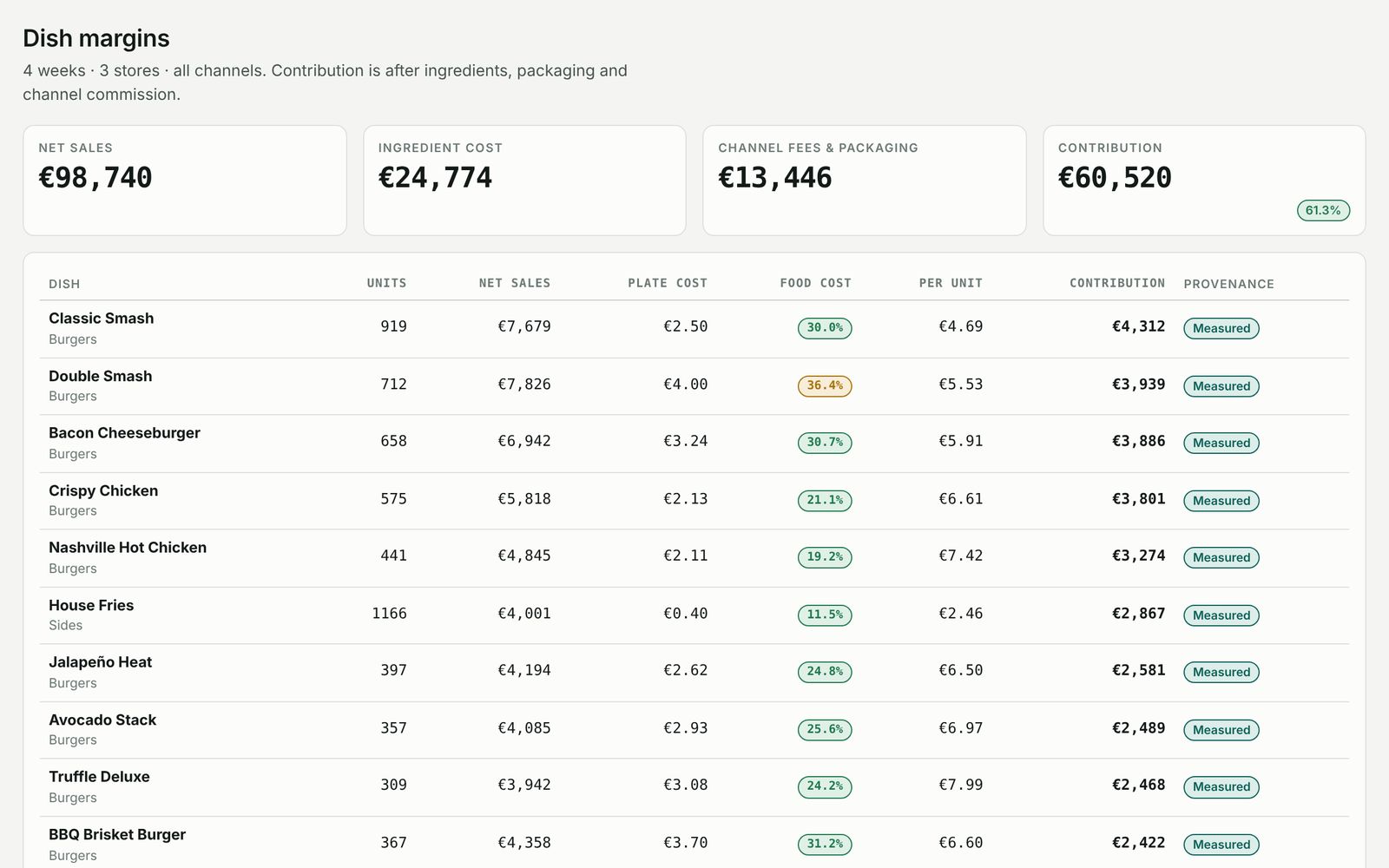
Popularity against contribution per dish. Stars to protect, puzzles to promote, plowhorses to re-engineer and dogs to replace.
See it on a demo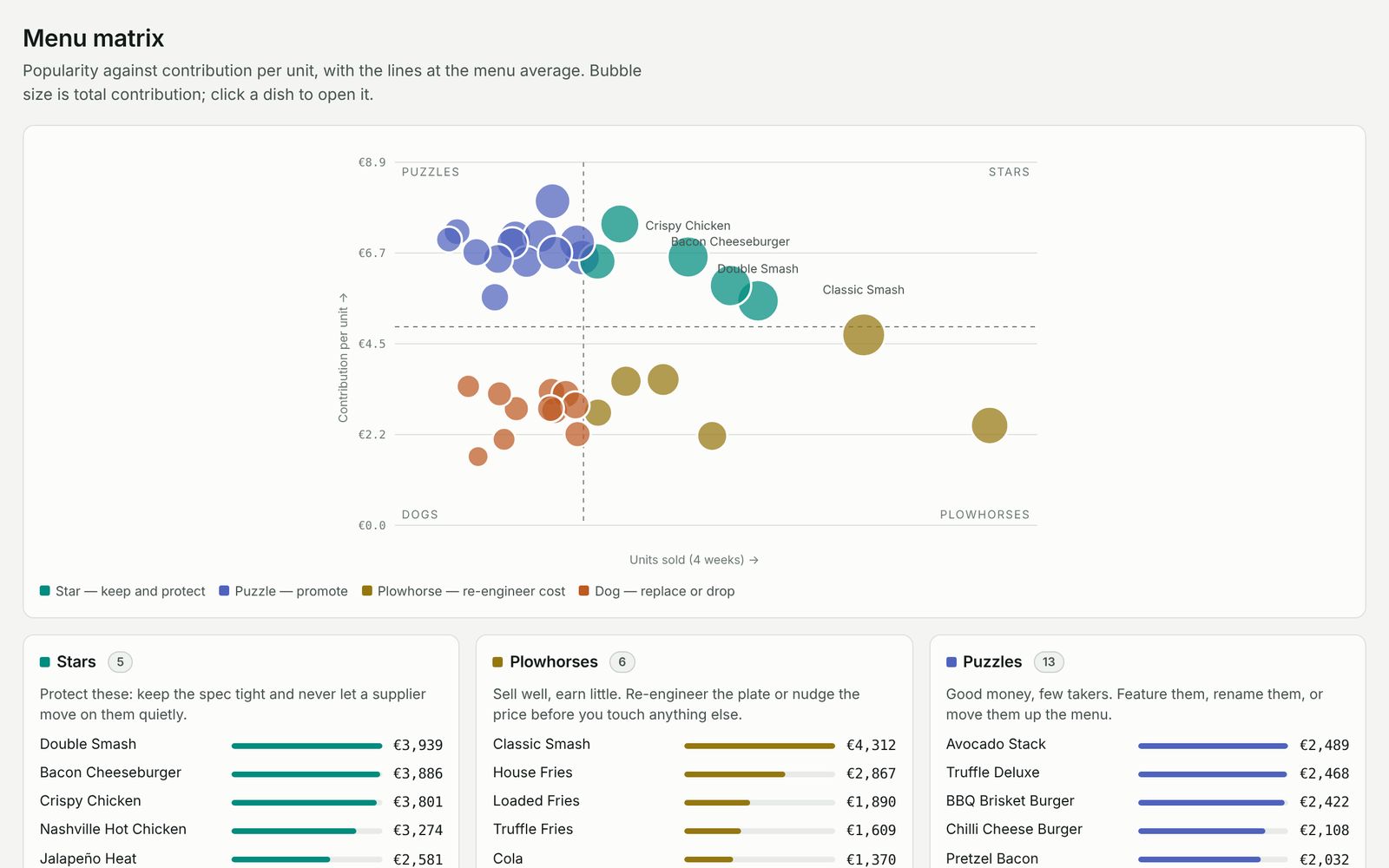
Dine-in, takeaway and each delivery platform side by side, after commission and packaging. Move an ingredient or menu price and every number follows.
See it on a demo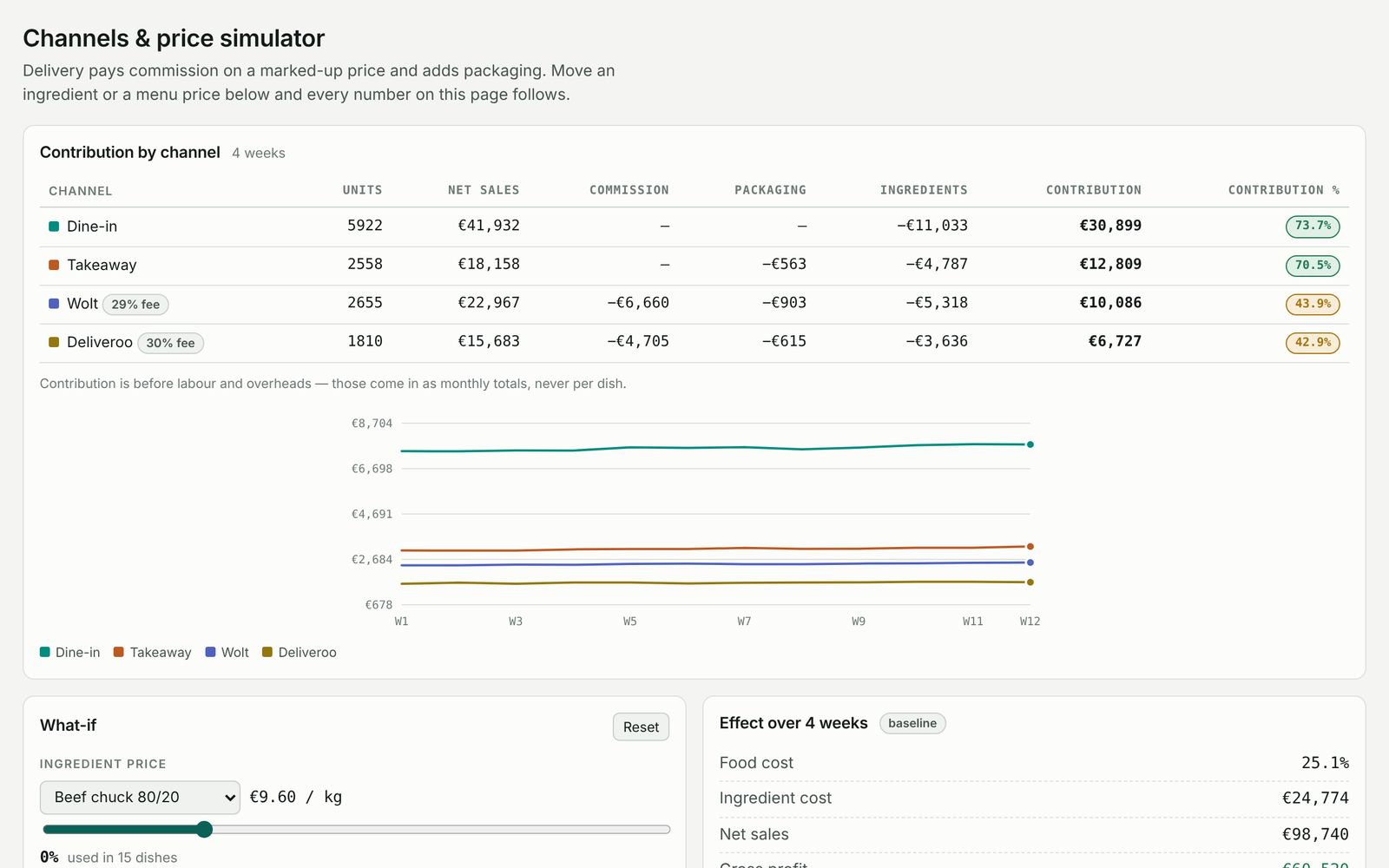
The product
FoodNormIQ is organised around the work in a kitchen: buying, costing, selling and counting. This week pulls the few changes worth money to the top, so you don't have to read every report.
See price changes before they become margin problems.
Know exactly what each dish costs today, and what it cost before.
Know what each channel actually leaves you.
Know what should be on the shelf.
Decide ahead, and see what the kitchen really makes.
Getting started
Recipes in a binder, invoices as photos and odd POS exports are normal. Setup is done with you, not handed to you.
Binders, spreadsheets, photos or the chef's notes become structured recipes with yields and sub-recipes. We confirm the uncertain ones with your chef.
We read your past invoices. From then on you forward new ones to your own intake address, and your POS sends the day's sales each night.
Costs, stock and channel margins are current when you open the app, with the changes worth acting on at the top.
Your team signs in with email or Google. Each person sees only the areas you allow, and every change is logged with who made it.
Who builds it

I spent nine years running purchasing and sales for a multi-million-euro product portfolio. I negotiated with suppliers, defended category margin, and watched how quietly a good product line stops making money when input prices move and nobody re-costs anything.
Then I spent a decade building the reporting that shows it. As a BI consultant I've delivered more than 100 dashboards for retail and distribution clients, covering sales, stock, purchasing, supplier performance and margin.
FoodNormIQ started as a costing model for one real kitchen: recipes broken down to the gram, invoice prices flowing into every affected dish, and sales allocated back against them. It answered a question the owner couldn't answer from the P&L: which dishes are actually worth cooking.
You'll deal with me directly, not a support queue.
Pricing
Your first location is included and every user gets their own sign-in at no extra cost. Start with the free audit before you choose.
Stop losing money on supplier prices.
€199a month
First location included
No recipes needed. Add Digitised Menu for €29 a month.
Start with a free auditMake the menu itself more profitable.
€299a month
First location included
Everything in Purchase IQ, plus
Unlimited recipes.
Start with a free auditRun the whole business on it.
€499a month
First location included
Everything in Menu IQ, plus
Book a demoor a free profit audit
On a demo we walk through the product live on a sample kitchen, or on your own invoices if you send a few first. Prefer proof on paper? The free profit audit uses a small slice of your real data, and you keep the analysis either way. Ten audits a quarter, done properly.
Illustrative. Your report uses your own invoices, recipes and sales.
Blogmargin notes for kitchens
A burger priced a euro higher on Wolt can still leave €2.25 less. How to work out contribution per delivery order, step by step.
Read the articleTrim and cooking loss mean you buy more than you serve. A simple yield test, and why it changes the price of every protein dish.
Read the articleThe menu matrix sorts every dish by popularity and contribution. What each group means and what to do with it.
Read the articleQuestions
Start with the invoices and recipes you already have. A demo takes about 30 minutes; the audit takes 3 to 5 days.